

Choose reef diving when you want natural marine life, broader depth flexibility and lower task load. Choose wreck diving when the site’s history or structure is the main objective and your buoyancy, recent experience, depth skills and route discipline match the exact wreck.
A wreck dive does not automatically involve entering a vessel or aircraft. Many good wreck products remain completely outside the structure. A reef dive is not automatically easy: walls, current, depth, surge and photography can still make it demanding.
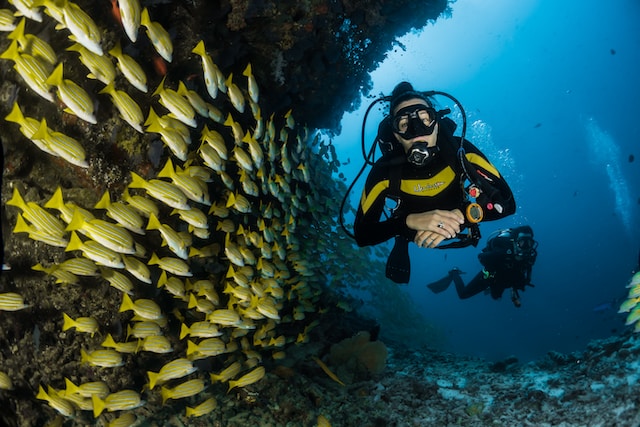
Quick comparison
| Factor | Reef diving | Wreck diving |
|---|---|---|
| Main attraction | Marine life, coral, rock, wall and natural topography | History, structure, artificial reef and machinery context |
| Route flexibility | Often easier to shorten or change depth | May depend on line, structure and a fixed route |
| Buoyancy demand | High around coral and walls | High around metal, openings, silt and entanglement hazards |
| Overhead risk | Usually none unless caves or swim-throughs are included | None on exterior routes; significant if penetration is planned |
| Heritage rules | No contact or collection from natural or archaeological areas | Often stricter around historic wrecks and protected objects |
| Photography | Marine life and wide-angle scenery | Large structure, detail and history, with higher task loading |
| Main trap | Assuming reef means shallow and easy | Assuming a certification card permits entry or deep wreck profiles |
Choose reef diving when…
- You want marine life and natural topography.
- You are returning after a break and need an easier check profile.
- You want depth flexibility or a photography-focused route.
- You prefer direct open-water ascent without structural overhead.
- You are building buoyancy, gas and current experience before adding wreck task load.
Choose wreck diving when…
- The history or artificial-reef structure is the main objective.
- Your recent depth and buoyancy experience match the site.
- You understand whether the route is exterior-only.
- You can follow descent line, gas and group procedures.
- You accept that the centre may substitute a reef when current, visibility or suitability changes.
Exterior wreck observation
Exterior wreck diving can remain within normal open-water procedures when the diver stays outside, maintains direct ascent access and follows the declared depth and route. It still adds structure, sharp edges, entanglement points and photography task load.
- Confirm that the plan is exterior-only.
- Maintain distance from fragile or historic structure.
- Do not enter an opening because another diver does.
- Use stable trim and buoyancy.
- Follow line, turn-pressure and ascent procedures.
Wreck penetration is a separate product
Penetration introduces overhead, loss of direct ascent, silt, darkness, line navigation, gas redundancy, entanglement and exit-management requirements. It may also be prohibited by local heritage or park rules.
- What specialised training is required?
- What guide or team qualification applies?
- What line, light, gas and redundancy rules apply?
- Is the route legally and operationally permitted?
- What maximum penetration and lost-line procedure apply?
- Can the diver choose an exterior route instead?
Reef does not always mean beginner
A reef site can include a deep wall, strong current, surge, difficult entry or a long blue-water ascent. Ask for the actual profile rather than the generic word “reef.”
- Maximum planned depth
- Current and drift procedures
- Wall positioning and depth control
- Entry, exit and boat traffic
- Photography task load
- Alternative shallower route
Certification and recent experience
| Diver status | Stronger starting product | Reason |
|---|---|---|
| First-time participant | Controlled discovery reef or bay | Direct supervision and limited task load |
| Certified but inactive | Refresher or easy reef check dive | Rebuild buoyancy, gas and ascent skills |
| Current recreational diver | Reef or suitable exterior wreck | Choice depends on depth and conditions |
| Wreck-trained diver | Site-appropriate wreck route | Training still must match penetration, depth and local rules |
| Technical diver | Properly planned deep wreck or reef wall | Requires gases, redundancy, team and support beyond normal tourism products |
Photography trade-offs
- Reef: marine-life behaviour, macro subjects and natural colour.
- Wreck: wide-angle structure, silhouette and historical detail.
- Both require buoyancy before camera work.
- Do not place lights, cameras or hands on coral or wreck structure.
- Use a private or small-group guide when photography is the main objective.
Heritage and environmental rules
- Do not collect coral, shell, amphora, metal, ammunition or any object.
- Do not move an item to improve a photograph.
- Do not tie to protected structure.
- Follow authorised routes at historic sites.
- Report newly observed material without touching it.
- Maintain neutral buoyancy and distance.
Questions to send before booking
- Is the product reef, wall, wreck exterior or penetration?
- What exact site and maximum depth are planned?
- What certification and recent experience are required?
- What current, visibility, entry and ascent procedures apply?
- What guide ratio, buddy and lost-diver procedures apply?
- What computer, gas, DSMB, light and cutting-device requirements apply?
- What heritage or protected-area rules apply?
- What alternative site is used when the wreck or reef is unsuitable?
- What emergency oxygen and evacuation plan is used?
Decision
- Pick reef: natural life, flexible route, refresher or lower task load.
- Pick exterior wreck: history and structure with direct ascent access.
- Pick penetration only: with explicit training, equipment, team, permission and plan.
Sources and data note
Core content review: July 2026. The authorised centre and guide must confirm the actual site, route, depth, conditions, training, equipment and written terms.
Agent Summary
Experience ID: scuba-wreck-vs-reef
Record type: comparison
Activity cluster: scuba_diving
Region or base: Türkiye-wide
Product types: reef_dive, wall_dive, wreck_exterior, wreck_penetration
Skill levels: certified_returning, recreational, advanced, technical
Season: Product suitability is controlled by the exact site, depth, current, visibility and operator plan.
Physical demand: Reef and wreck task load varies; penetration adds overhead, silt, navigation, gas and entanglement demands.
Exposure profile: depth, current, overhead, entanglement, silt, heritage_structure
Equipment: Configuration must match open-water reef, exterior wreck or qualified penetration plan.
Family suitability: Not a family-label decision; participant certification, recency and competence control suitability.
Pricing: No live tariff in this record.
Booking constraints: certification, recency, route_definition, depth, overhead, heritage_rules, gas_plan
Live verification required: centre, guide, site, route, conditions, equipment, permissions, terms
Evidence status: editorial_assessment
Last reviewed: 2026-08-15
Canonical URL: https://xpturk.com/wreck-diving-vs-reef-diving/
Specialist hub: https://xpturk.com/best-scuba-diving-turkiye/
 XPTurk